5 Habits That Will Make You Disgustingly Intelligent. And Why I Find That Disgusting.

"Humans are creatures of habit." Since the first time I heard this sentence I kept coming back to it way too often. I have been searching for the reason why. I think it's because it truly unsettles me.
My parents used to say we eventually become what we eat. These days they are eating goose.
I think it's really funny how much this nonsense stuck with me as a kid. But actually they might have been up to something.
That what we repeatedly consume, what we repeatedly do, what we repeatedly think about, eventually becomes what we are. Not metaphorically. Literally. In the physical structure of our brains.
Five habits that will make you disgustingly intelligent.
I came across this carousel on TikTok. I saved it. Then I felt like an evil person.
Read it twice, came back to it every week, and sat with a strange feeling I couldn't quite explain. The habits they shared seemed reasonable. It was something about being interested in this and how that thought made me feel.
The thought that deliberately engineering yourself to become smarter sits uncomfortably close to something I see everywhere and am trying very hard not to become. I think "narcissism" has become too big of a label on social media these days, and we all try not to become one. But where is the line between caring about yourself vs. excessively doing so? Borderline narcissism.
Is trying and aspiring to become a better person, for the pure sake of yourself, borderline narcissism? That was an intrusive thought I had, especially since these days we do not become better without documenting the process.
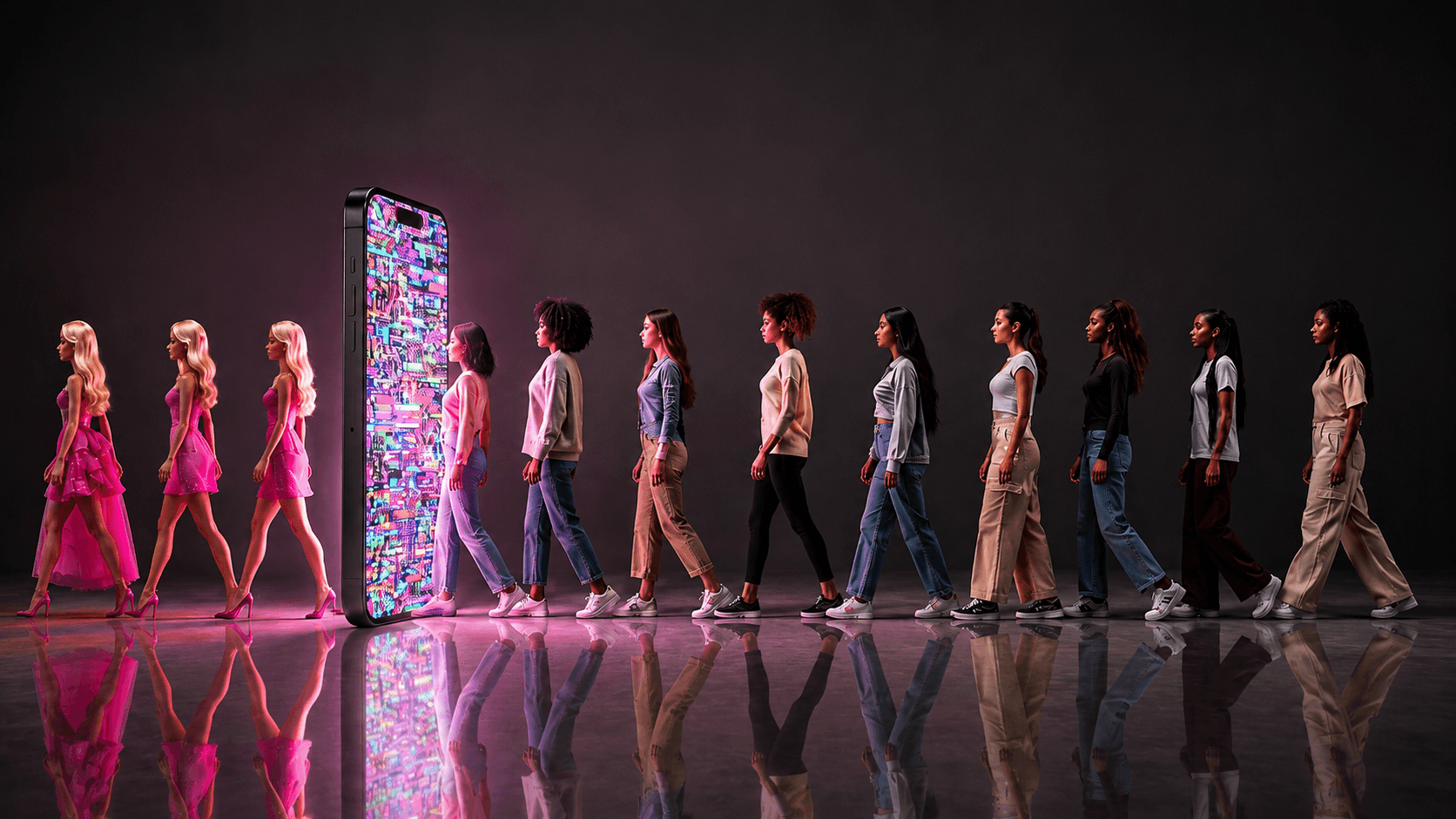
I think we are all aware that there is a huge part of the internet devoted to performing self-construction. Morning routines filmed before sunrise. Productivity systems optimized down to the minute. Personal brands built around becoming "the best version" of yourself.
And if I'm honest, I find myself instinctively pulling away from all of it. Not because growth bothers me. Because performance does.
Which leaves me with a question I haven't managed to answer.
Can you intentionally shape yourself without turning yourself into a self-improvement caricature?
Because whether you participate in that culture or not, your brain is already changing. By what you read today. By what you scrolled through this morning. By the conversation you avoided. By the problems you solved. By the thoughts you repeated. Whether you're paying attention or not.
Aren't we, in the end, creatures of habit?
Gen Z Named Their Own Cognitive Decline Before the Scientists Did.
I love the word "brain rot," it is so accurately describing something that is happening to us, that perhaps older generations haven't really experienced. I won't lie, I do enjoy a brainrot sesh here and there.
Brain Sciences, a paper published last year, defines brain rot as the cognitive decline and mental exhaustion associated with prolonged exposure to low-quality digital content. Doomscrolling, compulsive social media use, and endless short-form entertainment measurably impair executive functions like memory, planning, and decision-making.
Average sustained attention has typically fallen from around two and a half minutes in 2003 to just 47 seconds among frequent social media users two decades later.
That isn't really a gradual decline. It's a collapse.
But Gen Z didn't just recognize it, made it a proper self-criticism and positioned it as a joke, very on brand for us, but are also leading the retreat from it.
Dumbphones. Film cameras. Paper books. Long walks without headphones. Analogue January.
It looks like fashion-driven nostalgia on the surface. But what if underneath it, it is something much more interesting. Perhaps a movement to reclaim a brain they can feel changing.
Because neuroscience proves it possible. If habits can quietly weaken a brain, why couldn't they also deliberately strengthen one?
With All Due Respect to the Philosophers, They Got This One Slightly Wrong.
I am going to quote Aristotle here. The guy constantly gets the credits for saying "we are what we repeatedly do, excellence then is not an act but a habit."
Nobody really questions it. Which is exactly why I did.
Because Aristotle never actually wrote those words. It was the historian Will Durant in 1926 summarising Aristotle for a general audience. A paraphrase that became a quote that became a tattoo that became a LinkedIn caption that everyone has seen approximately 400 times.
What Aristotle was actually trying to say is more interesting. Character is not something you are born with. It is something you practise into existence. You do not become brave by occasionally performing a brave act. You become brave by repeatedly doing things that require courage when it would be easier not to.
Character in this view is not a personality trait. It is a pattern. A collection of repeated choices that slowly hardens into an identity.
The neuroscience gives this a physical explanation. To become a licensed London taxi driver, trainees must memorise 25,000 streets across central London. The training takes 3 to 4 years. Only half of candidates pass. Researchers scanned the brains of 79 trainee drivers at the start and end of this process. Those who passed showed measurably larger hippocampi, the brain region responsible for spatial memory, compared to those who failed and to non-drivers.
The critical detail. At the beginning of the study, all groups showed no discernible differences in brain structure. The change happened as a result of the training. Not as a precondition for it.
They grew new grey matter. Through habit. Over time.
My parents were right. You eventually look like what you repeatedly consume. They just didn't have the neuroscience to prove it. And they were eating goose.
There is also a twist worth sitting with. The taxi drivers who grew larger hippocampi showed poorer performance on other visual memory tasks. Growing your brain in one direction can mean shrinking it in another. Every habit is a trade-off. Every skill you cultivate is also a choice about what you are not cultivating.
So. The Post. Here Is What the Science Actually Says.
The tips in that carousel, and the science behind why they actually work.
1. Reverse Learning. Read the last chapter of every book first. Your brain creates mystery gaps when it encounters information out of sequence. Those gaps force active problem-solving rather than passive absorption. You engage differently with material when you already know the destination and are working backwards to understand how it gets there. Your brain stops receiving and starts interrogating.
2. Sensory Deprivation Thinking. Spend 10 to 15 minutes in as close to silence and stillness as you can manage before a creative challenge. Walk without your phone. Sit without a screen. Fold laundry. Copy something by hand. When your brain is not focused on a task, the default mode network activates. That network is responsible for daydreaming, memory consolidation, self-reflection, and creative thinking. It is the network behind your best ideas in the shower, the solution that appears on a walk, the thought that surfaces when you stop trying to find it. Strategic boredom before creative work improves subsequent performance by 25 to 40%. Boredom is not the enemy.
3. Pattern Interruption. Write with your non-dominant hand for 10 minutes daily. Learn something in a completely different domain than your own every week. Study medieval poetry then quantum physics. The brain builds intelligence through unexpected connections. Cross-domain knowledge is where original thinking lives. Doing things differently forces new neural pathways. Doing the same things the same way every day builds a very efficient but very narrow brain.
4. Strategic Confusion. Put your phone in another room when you need to think. A University of Texas study found that subjects performed significantly lower on working memory and fluid intelligence tests when their phone was on the desk next to them, even though they never touched it. The mere presence of the device drained cognitive resources. You do not even need to be scrolling. Proximity is enough. The confusion is in thinking you are fine because you are not looking at it.
5. Argument Reversal. Defend the opposite of what you believe for 15 minutes. Not to change your mind. To understand complexity beyond your own biases and make your original position genuinely unshakeable rather than just confidently held. The anterior cingulate cortex, the brain region involved in learning and error monitoring, activates more strongly in people who practise this. Their brains literally pay more attention to information that challenges them. Your thinking gets sharper by being forced to fight itself.
Caring About Yourself vs. Performing That You Do.
Now that I shared them with you, let me go back to where I started. The feeling I had when I saved that carousel. Imagine I had reposted it. I would have felt like the darkest person alive.
Reposting or liking it would have signaled to everyone that I want to be smarter. That I am actively trying to become something I am not yet. That I looked at myself and thought, this needs work, and then told the internet about it.
Isn't that just a very elaborate way of deceiving people into seeing a version of me that doesn't fully exist yet? In the end, shouldn't we just be grateful for the qualities we've got by default?
There is something to that. The idea that who you are, the way your brain naturally works, the instincts you were born with, the curiosity that showed up without you asking for it, has its own value. That constantly trying to optimise yourself is a way of saying what you already are is not enough. And that maybe the self-improvement industrial complex is just a very sophisticated and socially acceptable form of self-rejection.
But self-directed neuroplasticity is a thing. You can, in fact, consciously shape your brain's structure through intentional practice rather than just experiencing whatever your default habits are. On one hand, the London taxi drivers were just memorising streets. For four years. Which happened to grow new grey matter.
On the other hand, they also did not choose to grow their hippocampus. They chose to pass a test.
So what is the difference between that and consciously looking to become more intelligent?
That self-improvement content does something different. It makes the brain the destination. The growth the aesthetic. The habit the identity signal.
That is where it all tips into something uncomfortable. Wanting to grow isn't wrong. But performing wanting growth as a substitute for actually growing is. Liking, reposting content like that, without actually following through, is what I'd find disgusting.
These 5 habits are genuinely fun to experiment with. Not because I want to seem like something I am not. But because I am curious to learn what happens if I follow through.
We are creatures of habit. True. But it was never about the habit. It is always about the reason.
Today's micro-fable:
A student came to a philosopher and asked how to become wise. The philosopher handed him a bucket and told him to fill it from the well at the edge of the city every morning for a year. The student thought this was beneath him but did it anyway. A year later he returned. The philosopher asked what he had learned. The student said: nothing about wisdom. But my arms are stronger and I know every stone on that road better than I know my own face. The philosopher proudly nodded.